Design of Experiments
Statistical software programs contain extensive capabilities for the creation and analysis of statistically designed experiments. The designs that can be created are divided into several types, as listed below.
Screening Designs
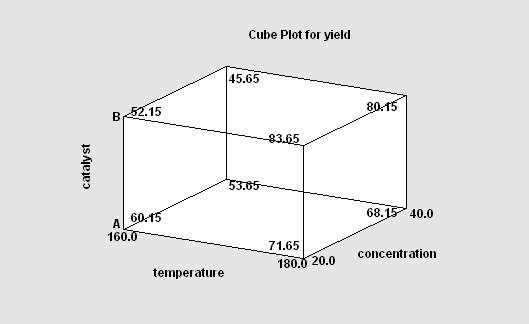
Screening designs are intended to determine the most important factors affecting a response. Most of the designs involve only 2 levels of each factor. The factors may be quantitative or categorical. Included are 2-level factorial designs, mixed level factorial designs, fractional factorials, irregular fractions, and Plackett-Burman designs. For designs of less than full resolution, the confounding pattern is displayed. Blocking and randomization are options.
Response Surface Designs
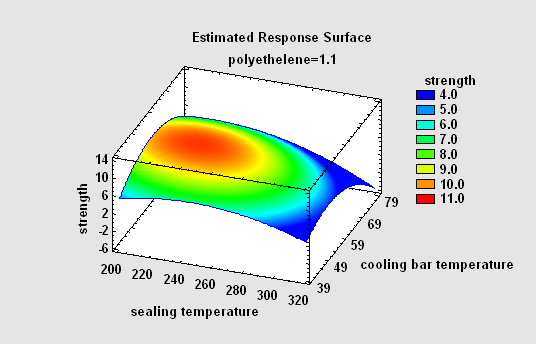
Response surface designs are intended to determine the optimal settings of the experimental factors. The designs involve at least 3 levels of the experimental factors. Included are central composite designs, Box-Behnken designs, 3-level factorials, Doehlert designs, and Draper-Lin designs.
Mixture Experiments
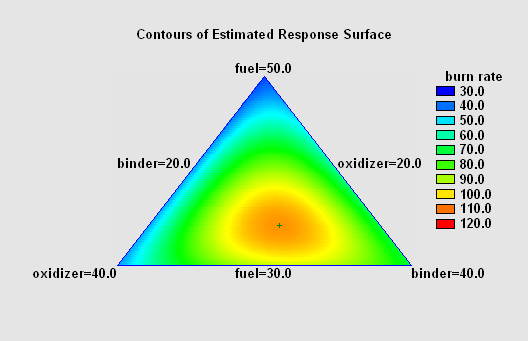
Mixture experiments involve components of a mixture, where the levels of the components are constrained to sum to 100% (or some other fixed value). Upper and lower constraints may be specified for each component. Included are simplex-lattice, simplex-centroid, and extreme vertices designs.
D-Optimal Designs
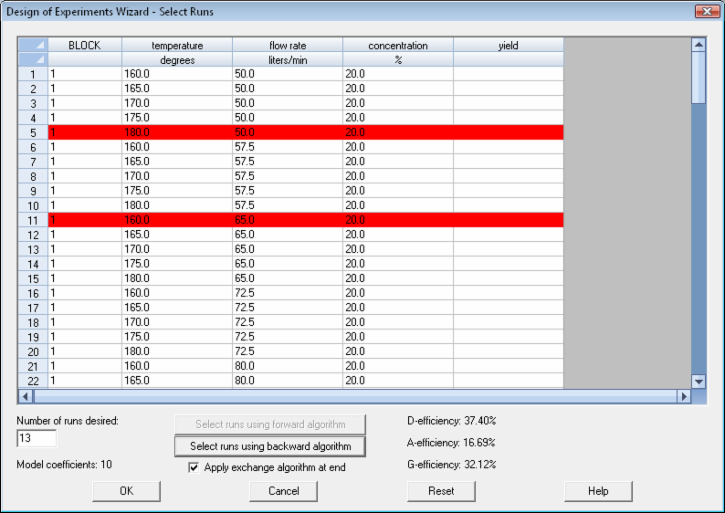
D-optimal designs are designs that seek to minimize the covariance matrix of the estimated coefficients in a specific statistical model. They are commonly used when the design region is constrained, or when additional runs need to be added to an undesigned experiment to improve its statistical properties. Users typically begin by creating a set of candidate runs using a multilevel factorial design. The program then selects an optimal subset of those runs by applying either a forward selection or backward selection plus an exchange algorithm. The result is a design with high D-efficiency, given the constraints.
Robust Parameter Designs
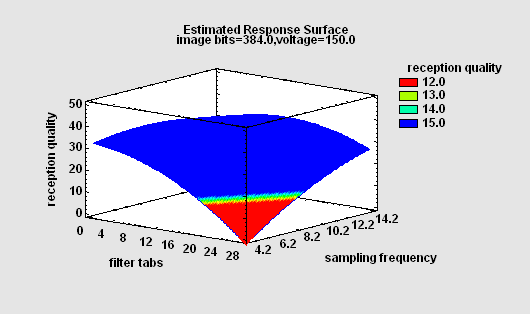
Statgraphics can create experimental designs for use in robust parameter design (RPD). In such experiments, two types of factors are varied: controllable factors that the experimenter can manipulate both during the experiment and during production, and noise factors that can be manipulated during the experiment but are normally uncontrollable. The goal of RPD is to find levels of the controllable factors where the response variables are relatively insensitive to changes in the noise factors. RPD designs may be created using either the crossed approach of Taguchi (with inner and outer arrays) or the combined approach of Montgomery (both types of factors varied in a single array).
Single Factor Categorical Designs
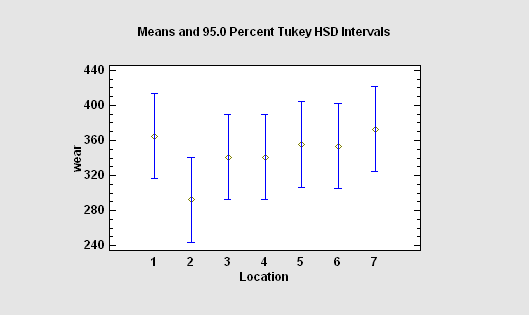
Single Factor Categorical designs are used to compare levels of a single non quantitative factor. They include completely randomized designs, randomized block designs, balanced incomplete block (BIB) designs, Latin Squares, Graeco-Latin Squares, and hyper-Graeco-Latin Squares.
Multi-Factor Categorical Designs
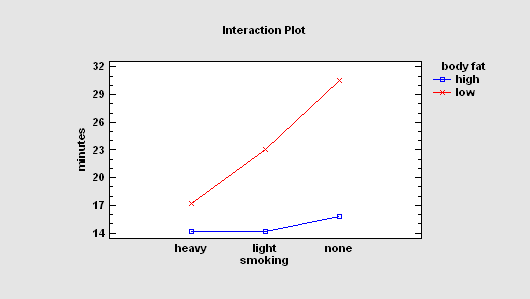
Multi-Factor Categorical designs are used to study multiple non-quantitative factors, with several levels of each. They are analyzed using a multifactor analysis of variance.
Variance Component Designs
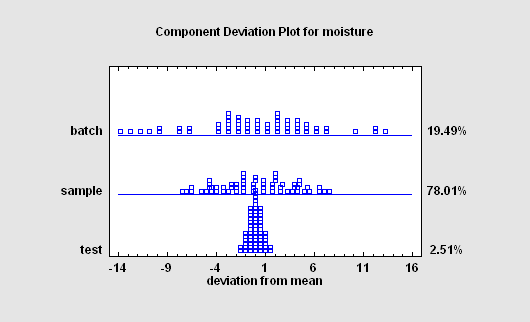
Variance Component (hierarchical) designs are used to study the effect of two or more nested factors on the variability of a response. Estimates of the contribution of each factor to the overall variability are obtained.
Design of Experiments Wizard
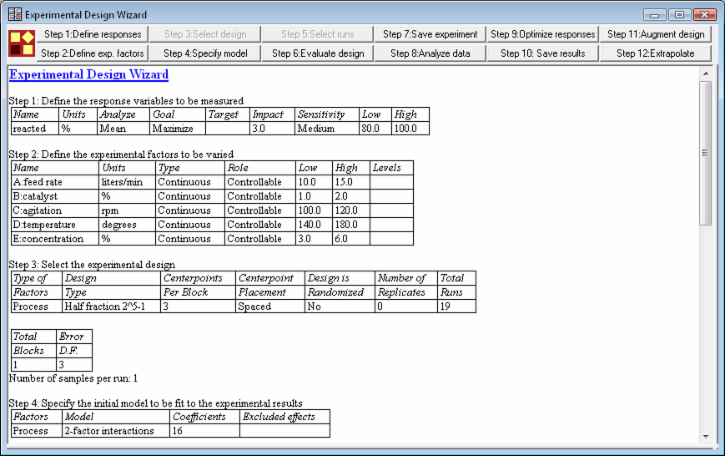
Statgraphics Centurion contains a wizard that assists users in constructing and analyzing designed experiments. It guides the user through twelve important steps. The first 7 steps are executed before the experiment is run. The final 5 steps are executed after the experiment has been performed.
Multiple Response Optimization
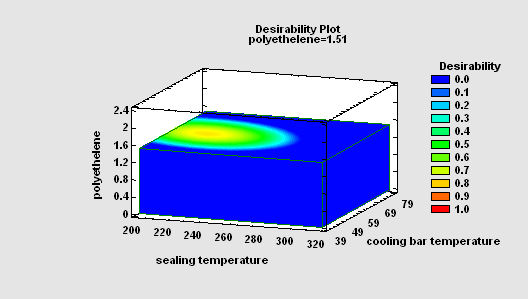
In order to find a combination of the experimental factors that provides a good result for multiple response variables, Statgraphics uses the concept of desirability functions. Desirability functions provide a way to balance the competing requirements of multiple responses, which may be measured in different units. Users specify the target value or acceptable range for each response, together with its relative importance.